
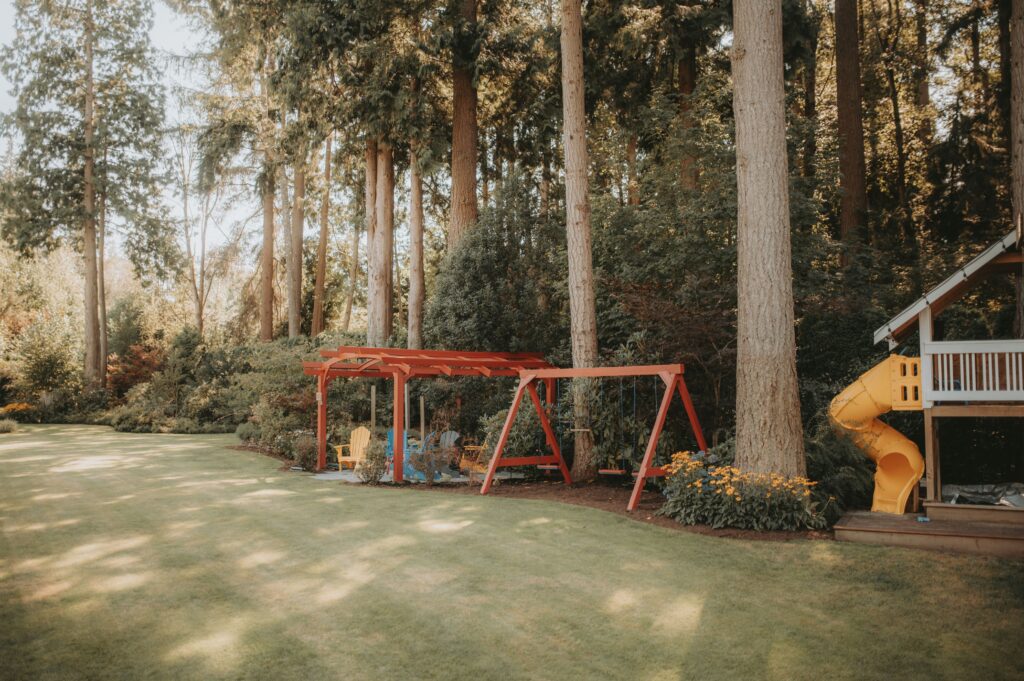
Most people pick the spot in about thirty seconds. Back corner, against the fence, wherever the lawn looks emptiest. Done.
Then they spend the next five years watching their kids drag the swings into a worn dirt patch, picking splinters out of hands from a fence too close to the frame, squinting into the afternoon sun while pushing a toddler, and rotating the mulch that won’t stay put.
The placement decision matters more than people give it credit for. Get it right, and the swing set quietly integrates into the rhythm of the yard. Get it wrong, and you’ve built a play zone nobody enjoys using by July.
So where should it go? A few questions worth working through before the post-holes get dug.
How much clearance do you really need?
This is the one most parents underestimate. A swing in motion needs roughly two metres of clear space in front and behind the seat at full arc, plus another metre and a half on either side for kids jumping off. That’s a lot more room than the manufacturer photos suggest, because manufacturer photos are shot at flattering angles with no neighbours.
Brands like Vuly swing sets publish exact clearance requirements for each model in their assembly guides, and the numbers are worth checking before you commit to a spot. Take the Max range. The footprint looks modest on paper but expands once you factor in the swing arc and the safe-fall zones. If you’ve got a yard that’s already tight, those extra metres can be the difference between a workable installation and a swing seat that clips the trampoline every time someone goes high.
Which way should the swings face?
In Canada, a swing set facing west turns into a glare trap from about 3pm onwards through summer. Kids squint, parents squint, the seat itself heats up if it’s a darker plastic, and the swing chains can get hot enough to sting. Facing east is better for afternoon play but worse if you’ve got early-rising toddlers who want to swing before breakfast.
The sensible orientation in most yards is north-facing seats, which keeps the sun behind the swinger for most of the day. South-facing works too, and gives you the longest period of usable shade if you’ve got a tree line behind the frame.
Wind matters less, but worth a thought. A swing set that catches the prevailing breeze will see swings drift and tangle when nobody’s on them. Tucking it slightly behind a windbreak (a hedge, a shed, a side fence, even a row of tall planters) keeps the ropes from knotting themselves into spaghetti.
What’s underneath?
Lawn looks lovely on day one. By month four, the area under each swing is bare dirt, and by month eight, it’s a mud pit that tracks into the house every time it rains.
The serious options are wood mulch, rubber chips, pea gravel, or engineered wood fibre. Each has trade-offs. Mulch is cheap and absorbs falls well but needs topping up annually. Rubber is expensive upfront but lasts a decade and provides the best impact protection. Pea gravel drains beautifully but kids will throw it, and a stone in the eye is a hospital trip nobody wants.
Whatever you choose, you need a depth of around 23 centimetres for fall protection on equipment up to two metres high, and you need a border to keep the material from migrating into the lawn. Pressure-treated timber edging, recycled plastic, galvanised steel, or concrete kerbing all work. Skip the loose-laid bricks. They get kicked out within weeks.
If the spot you’re considering doesn’t drain well, fix that first or pick a different spot. Standing water under a swing set is how you end up with rot in the timber components and rust in the steel ones.
How close to the house should it sit?
Two competing instincts pull at this decision. Close enough that you can supervise from the kitchen window. Far enough that the screaming doesn’t go straight through the dining room glass.
The middle ground sits at around 8 to 12 metres from the back of the house in most suburban yards. Close enough to see and hear, far enough that conversation indoors isn’t drowned out. You also want the sight lines clear from wherever you spend the most time, whether that’s the kitchen sink, the back deck, the home office window, or wherever you sit with a coffee. If a fence post or a tree blocks the view of the swings, kids work that out within a week and start using the blind spot for things you’d rather they didn’t.
The other consideration is windows. A wayward kick from a swing seat travels further than you’d think, and a basketball-sized impact on a sliding glass door is an expensive surprise. Keep the swing arc pointed away from glazing where you can.
What about the neighbours?
Worth a thought, even if it feels awkward. A swing set positioned right against a shared fence puts your kids’ shouting two metres from the neighbour’s bedroom window. It also puts the neighbour’s dog two metres from your kids, which can go badly in either direction.
A buffer of three metres from a shared boundary tends to keep everyone friendly. If the yard doesn’t allow that, a quick conversation with the neighbour before installation costs nothing and saves a lot of awkwardness later.
The other neighbour issue is overlooking. Tall A-frame swing sets give kids a vantage point over fences they couldn’t otherwise see across. Most neighbours don’t love being observed from a height while sunbathing. Lower-profile designs or a strategically placed hedge sort this out.
Should it go on a slope?
Short answer: no, but if you have to, level the platform first.
Swing sets need a flat base for safety reasons. The legs distribute load evenly only when the frame sits true. On a slope, one leg ends up bearing more weight than the others, the frame racks slightly with every push, and over a few years the joints loosen in ways that aren’t always visible.
If your yard slopes, the fix is a levelled pad. Either dig the high side down or build the low side up with retained fill. A few hours of earthworks at the start saves replacing a bent frame later. Most yards have one corner that’s flatter than the rest. Find that corner.
So where does it go?
The shortlist for most yards: north-facing or south-facing, level ground, three metres clear on all sides of the swing arc, 8 to 12 metres from the house, well-drained, and not directly under a tree that drops sap or branches in a storm.
If only one spot in your yard meets all of those, that’s your spot. If two or three do, the tiebreaker is sight lines. Pick the one you can see from where you spend the most time. The swing set that’s visible gets used. The one tucked around the side of the garage gets forgotten by August. Spend an afternoon getting the placement right. The swing set itself is the easy part.